Language and writing
A language without books
The Dacians spoke a language of the Indo-European family, related to that of the Thracians. No book written in this language has survived. What we know comes from personal names (Decebalus, Burebista, Zalmoxis, Dromichaetes), from the names of fortresses ending in -dava, meaning “settlement”, from dozens of Dacian plant names preserved in medieval lists after Dioscorides, and from the Romanian words that linguists consider inherited from the old stock.
- Books preserved in the Geto-Dacian language
- 0
- Alphabets used on the objects found: Greek and Latin
- 2
The inherited words
Linguists such as Ion I. Russu have proposed a list of Romanian words with no Latin counterpart, among them brad, mal, moș, copil, brânză, mazăre, viezure, balaur, ghiont, zară. The list is debated: for some words there are alternative etymologies, and the exact number depends on who is counting. That is why we give no fixed figure.
How the Dacians wrote
Greek and Latin letters appear on the objects found. At Sarmizegetusa Regia, vessels with inscriptions in Latin letters were discovered; one reads Decebalus per Scorilo, usually interpreted as “Decebalus, [son] of Scorilo”, although the reading is debated. In Bulgaria, the ring of Ezerovo (fifth century BC) bears a Thracian text written in the Greek alphabet, still not fully understood. At Dionysopolis (today Balchik), a Greek decree honours Akornion, the envoy of Burebista, which shows that the king used Greek writing in his diplomatic relations.
What we know
- Greek and Latin letters appear on objects.
- A Greek decree from Dionysopolis honours Akornion, the envoy of Burebista.
What is debated
- The reading of the inscription “Decebalus per Scorilo”.
- The text on the ring of Ezerovo, not fully understood.
The message on the mushroom
Cassius Dio tells that, during the wars of Trajan, a large mushroom was sent to the emperor, with a message written in Latin, by which the allies of the Dacians advised him to withdraw. It is a curious story; it shows that Latin could be written in the Dacian world too, without our learning who wrote it.
The clay tablets of Tărtăria
In 1961 the archaeologist Nicolae Vlassa found at Tărtăria (Alba County) three clay tablets with incised signs, of the Vinča culture, thousands of years older than the Dacians. Some see them as a form of “proto-writing”, others as symbols with no value as text. They are not Dacian; we include them here because the discussion about the beginnings of writing on the territory of Romania always mentions them.
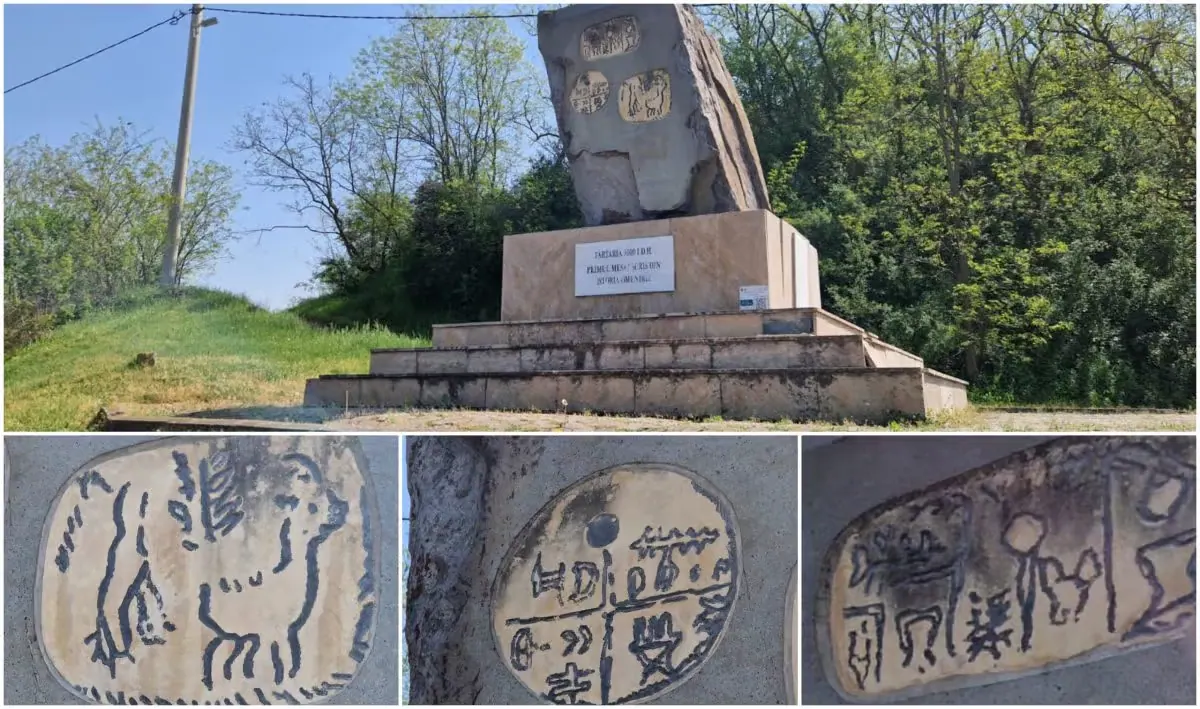 The Tărtăria tablets
The lead tablets of Sinaia
About the so-called Sinaia Tablets there is a separate file on this site. In the absence of a provenance and of a dating accepted by specialists, the academic community does not use them as a source for the writing of the Dacians. We do not present them as proof; we treat them as a subject of discussion.
The Belagines laws: what is known and what can be reconstructed
The only ancient mention comes from Jordanes, in the Getica (sixth century): the priest Decaeneus (Dicineus, in Jordanes) is said to have taught the Goths ethics, physics and logic and to have given them written laws, “which they still call belagines”. Jordanes mixes the Getae with the Goths, and some scholars link the name to a Gothic word for the laws of a community. The passage therefore shows above all a tradition about Decaeneus, not a Dacian text that has survived.
The text of these laws has not survived: we do not have even one article, in any language. The lists of dozens of articles that circulate online under the name “the Belagines laws” or “the laws of the Dacians” do not come from an ancient source and cannot be cited as a document.
What we know
- Jordanes mentions written laws called belagines and links them to Decaeneus.
- Other ancient authors describe customs and rules of the Getae and the Dacians, without calling them laws.
What is debated
- What the belagines contained and whether they existed as a text in their own right.
- How much of the passage concerns the Getae and how much belongs to the Gothic tradition.
- What the name means.
What can honestly be done is a reinterpretation: to gather from the ancient sources what they say about how the Getae and the Dacians ordered their lives, and to put it as principles. Below are six, each with the source it rests on.
- The soul before the body: life is a preparation for what follows, and concern for the soul comes before concern for the body (Herodotus, IV, 93–94; Plato, Charmides, 156d–157b).
- Moderation: measure in drink and in plenty, as far as giving up wine, on the advice of Decaeneus (Strabo, VII, 3, 11).
- Courage and justice: the Getae are called “the bravest and most just” of the Thracians (Herodotus, IV, 93).
- Heeding counsel: the word of the priest-adviser and the decision of the king hold the community together (Strabo, VII, 3, 11).
- Honesty in marriage: the virtue of the parents and faithfulness between spouses are the great dowry, and wrongdoing is paid for (Horace, Odes, III, 24, an idealised picture of the Getae and the Scythians).
- Mercy to the defeated: the plain table of the king who forgives his prisoner (Diodorus of Sicily, XXI, 11–12).
This is a modern reinterpretation, made by Explore Dacia from ancient testimonies: it is not a Dacian text and not a translation. The principles are put by us, in today’s language; each has beside it the source it rests on, and a historian may qualify or contest any point.
Conclusion
It can be said with certainty that the Dacians spoke a language of their own and that, in certain circumstances, they used Greek and Latin writing. It cannot be said that they had a writing of their own, and whoever claims the opposite owes the reader a proof.
It cannot be said that the Dacians had a writing of their own, and whoever claims the opposite owes the reader a proof.
Sources
- Ion I. Russu, Limba traco-dacilor, 1967 (Romanian words considered of native origin)
- Dioscorides, De materia medica (Dacian plant names preserved in medieval lists)
- Cassius Dio, Roman History, LXVIII, 8 (the message written on a large mushroom, in Latin)
- The inscription of Dionysopolis, in honour of Akornion, the envoy of Burebista (text in Greek, first century BC)
- The ring of Ezerovo (Bulgaria), fifth century BC (the longest known Thracian inscription, in Greek letters)
- Nicolae Vlassa, the discovery at Tărtăria, 1961 (clay tablets of the Vinča culture, much older than the Dacians)
- Jordanes, Getica, XI, 67–69 (Decaeneus and the written laws called belagines)
- Horace, Odes, III, 24 (the idealised portrait of the Getae and the Scythians)
Text written by Explore Dacia on the basis of the sources above; claims are attributed to their authors.