
Dacian wars and battles
Before Trajan: Burebista
Strabo shows that Burebista, the king of the first century BC, extended the power of the Dacians over a large territory and frightened the Roman neighbours. Suetonius notes that Julius Caesar was planning an expedition against the Dacians but was killed in 44 BC. Burebista died at about the same time, and the kingdom fell apart. The Dacians then passed into the shadows for almost a hundred years.
Julius Caesar was planning an expedition against the Dacians.
The war with Domitian (85–89)
Under king Decebalus the Dacians crossed the Danube and attacked the province of Moesia. Emperor Domitian sent armies, and the prefect of the praetorian guard Cornelius Fuscus was defeated and killed in 86 or 87; the date is not settled. In 88, the general Tettius Julianus won a battle at Tapae. The peace of 89 left the Dacians a kingdom recognised by Rome, with Roman money and craftsmen received as a gift, as Cassius Dio writes. Many historians see in this peace a dishonourable agreement for Rome, which is why Trajan later resumed the war.
Trajan’s first war (101–102)
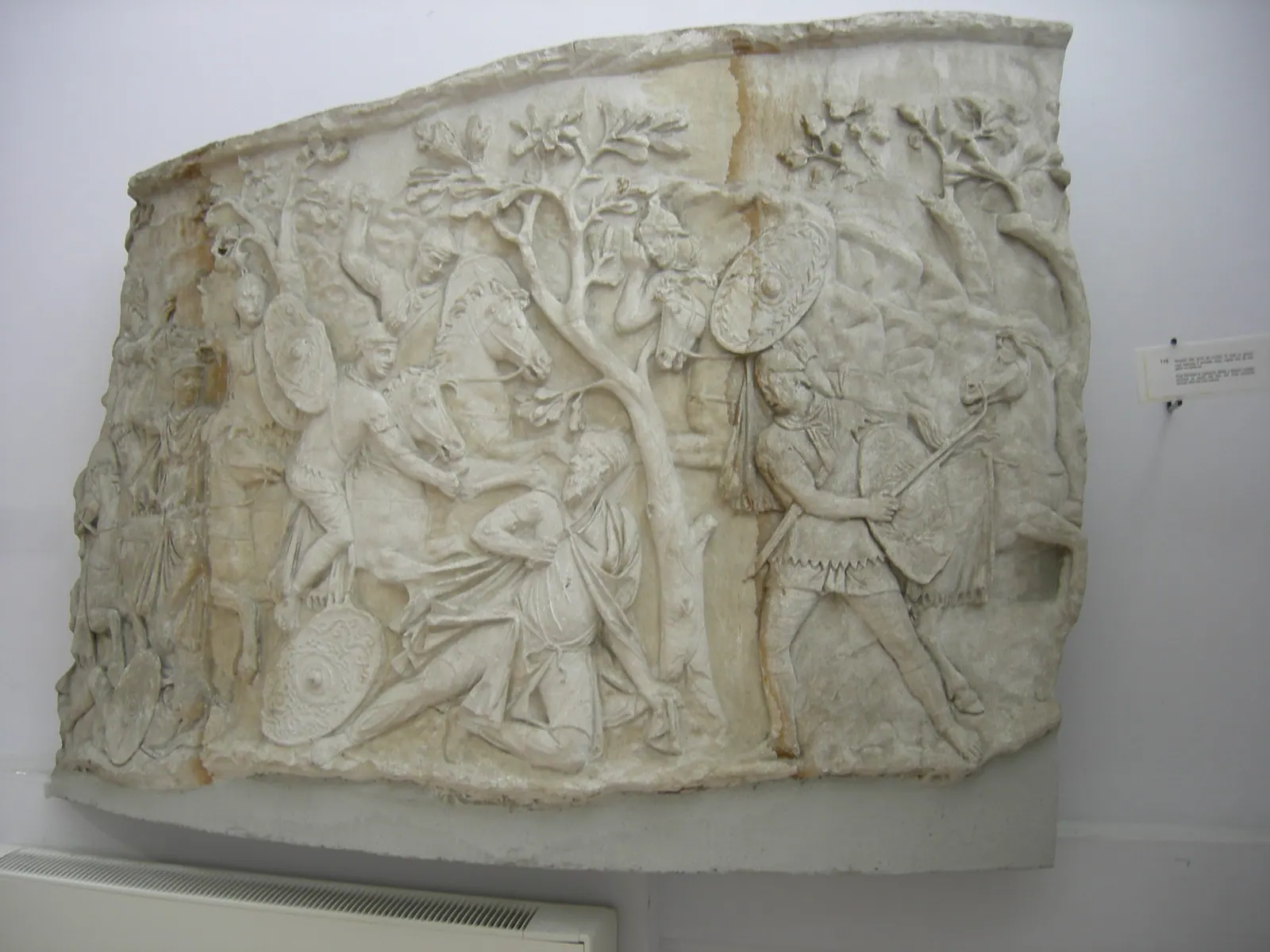
Trajan crossed the Danube in 101 and fought hard battles at Tapae. Trajan’s Column shows Roman soldiers caring for the wounded, using their clothes as bandages. In the following winter the Dacians attacked again, and in 102 Decebalus asked for peace; he agreed to pull down some of his fortifications and to receive Roman garrisons.
The second war (105–106)
Decebalus broke the agreement, and Trajan set out again. Cassius Dio says that the emperor built a stone bridge over the Danube, attributed to the architect Apollodorus of Damascus. The Roman army advanced towards the mountains, besieged Sarmizegetusa Regia and took it in 106. Decebalus fled, and when he was overtaken he took his own life; Cassius Dio adds that his head was taken to Rome. A scene of the Column is usually interpreted as his end, although not all historians agree.
- Wars between Dacians and Romans: 85–89, 101–102, 105–106
- 3
- The year Sarmizegetusa Regia was conquered
- 106
- The year Trajan’s Column was inaugurated
- 113
 Decebalus, king of the Dacians
How the Dacians defended themselves
The fortresses of the Orăștie Mountains were built with the murus dacicus technique, a wall of stone blocks with an earth and timber filling. The weapons that frightened the Romans most were the falx, a long knife curved inwards, and the sica. The Romans reinforced their helmets with iron bars across the crown; archaeologists link the change to the blow of the falx. It must be said that the link is a hypothesis, not a certainty.
What we know
- The fortresses of the Orăștie Mountains have walls of the murus dacicus type.
- The falx and the sica are attested Dacian weapons.
What is debated
- Whether the falx led to the Roman helmets reinforced with iron bars.
- The exact dates of the war with Domitian (85, 86 or 87).
After the war
Dacia became a Roman province in 106. Eutropius writes that Trajan brought people here from all corners of the empire. In 109 the monument at Adamclisi (Tropaeum Traiani) was inaugurated, and in 113, in Rome, the Column that tells the wars in stone.
A note on dates
The years of the wars vary in historical works: some begin the series in 85, others in 86, and the two wars of Trajan are dated by the Column and by Cassius Dio. We use the dates most often met and point out where they are debated. On them, the last word belongs to the historians.
The wars, step by step and on the map, are in Battlefield; their order in time is in the Timeline.
Sources
- Strabo, Geography, VII, 3 (Burebista and his power)
- Suetonius, Divus Iulius, 44 (Caesar’s plan against the Dacians)
- Cassius Dio, Roman History, LXVII and LXVIII (the wars of Domitian and of Trajan)
- Jordanes, Getica (the defeat of Cornelius Fuscus)
- Eutropius, Breviarium, VIII, 6 (the colonisation of Dacia after the conquest)
- Trajan’s Column, Rome, 113 (scenes from the two wars)
Text written by Explore Dacia on the basis of the sources above; claims are attributed to their authors.