Dacian art and literature
Gold and silver
The best-known Dacian art is jewellery. The gold spiral bracelets, with serpent-shaped ends or animal motifs, found in the Orăștie Mountains, are a symbol of Dacian art. Some of them reached the illegal market after the looting of the ’90s and were later recovered by the authorities; today they can be seen at the National Museum of Romanian History, in Bucharest. Fibulae, harness fittings and luxury vessels were also made of silver and bronze. Some pieces show Greek and Celtic influences, a sign that Dacian workshops did not live in isolation.
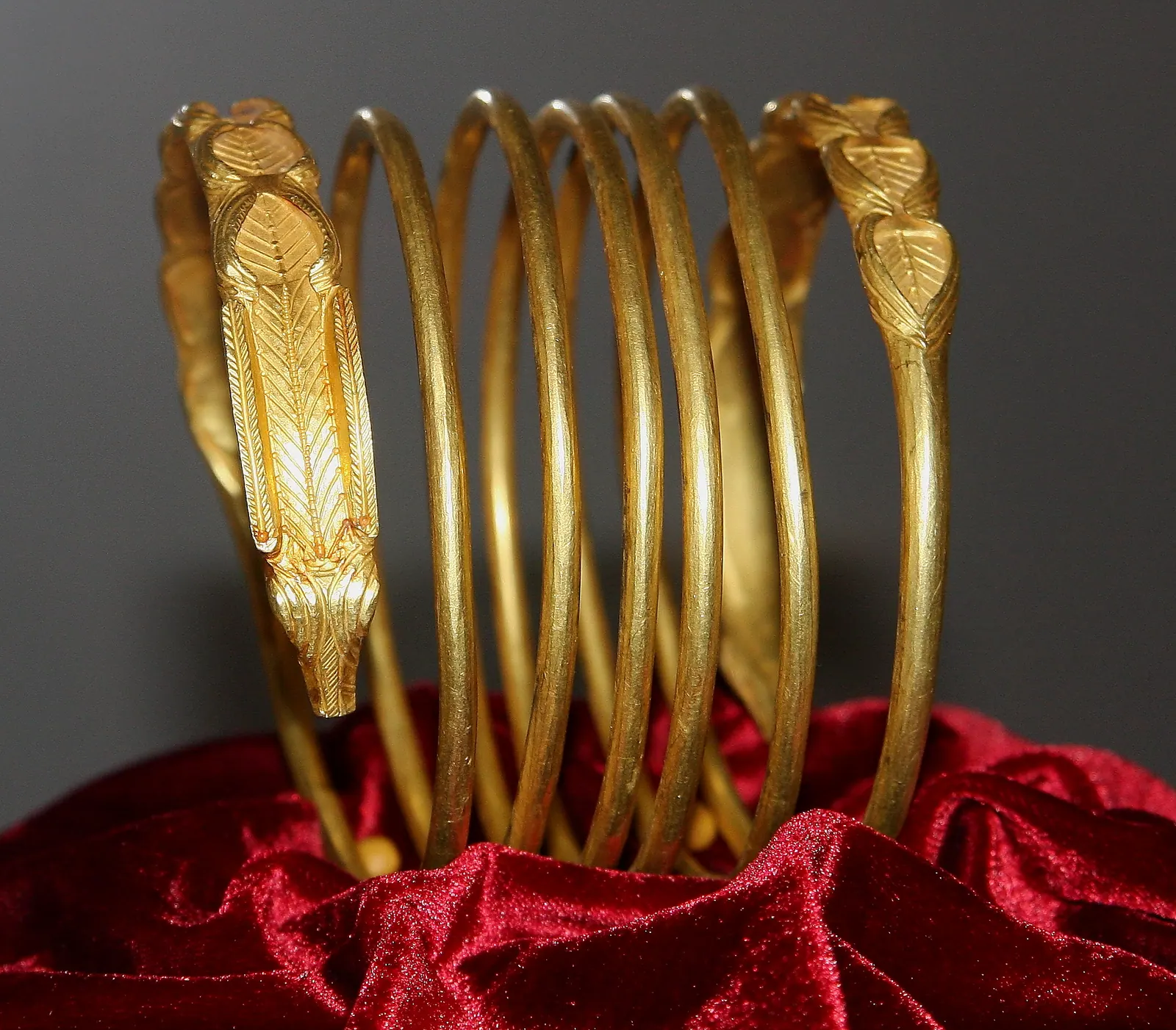 The spiral bracelet
What we know
- The gold spiral bracelets are kept at the National Museum of Romanian History.
- Some pieces show Greek and Celtic influences.
What is debated
- What the motifs (serpent, animals) meant and who wore them: the written sources do not say.
Pottery and tools
The Dacians made pottery in two ways: grey, wheel-made vessels, with Celtic and Greek influence, and hand-made vessels with raised bands. Large storage vessels, called dolia, were also found in the settlements of Orăștie. The iron tools (axes, hoes, knives, chisels) show a developed craft.
Trajan’s Column, a book in stone
The richest “story” of the Dacians was made by their enemies. Trajan’s Column, raised in Rome and inaugurated in 113, has a spiral frieze about 200 metres long, with more than 150 scenes and thousands of figures. It shows the dress of the Dacians, their fortresses, their weapons, their envoys and a scene usually interpreted as the end of Decebalus. It is not a neutral document: it is an image of the Roman victory. Used with this care, it remains the most important visual source on the Dacians.
- Scenes on Trajan’s Column
- Over 150
- Length of the spiral frieze
- About 200 m
- The year of the inauguration, in Rome
- 113
The richest story of the Dacians was made by their enemies.
Words about the Dacians
Ovid, exiled to Tomis (today Constanța) from the year 8, writes sad verses about the land of the Getae and says that he composed a poem in their language, now lost. From Antiquity we also have the pages of Herodotus, Strabo and Cassius Dio, quoted on the other pages of this section. A text by Trajan about the Dacian Wars, Dacica, has not survived.
The Dacians in modern literature
In the nineteenth century and at the beginning of the twentieth, the Dacians became a theme for writers and historians. George Coșbuc made Decebalus speak in the poem “Decebal către popor”. Vasile Pârvan published Getica in 1926, the first archaeological synthesis of the Geto-Dacian world. Mircea Eliade wrote De la Zalmoxis la Genghis-Han in 1970, on the religion and legends of the Dacians. They gave the Dacians a place in the imagination of the Romanians, alongside scientific research.
Beware of false “Dacian works”
“Dacian texts”, “Dacian alphabets” and “manuscripts” without provenance circulate on the internet. If they have no verifiable source, place of discovery and dating, we do not present them as authentic. The reader is invited always to ask where a piece comes from and who has studied it.
Sources
- Trajan’s Column, Rome, 113 (over 150 scenes, a frieze about 200 m long)
- National Museum of Romanian History, the historical treasure and the “Dacia” exhibition (gold and silver spiral bracelets)
- Ovid, Tristia; Ex Ponto, IV, 13 (the exile at Tomis, the poem in the Getic language)
- Vasile Pârvan, Getica. O protoistorie a Daciei, 1926 (the first archaeological synthesis of the Geto-Dacian world)
- Mircea Eliade, De la Zalmoxis la Genghis-Han, 1970 (the religion of the Dacians in the history of religions)
- George Coșbuc, the poem “Decebal către popor” (Decebalus in Romanian poetry)
Text written by Explore Dacia on the basis of the sources above; claims are attributed to their authors.