Dacian traditions
What is certain and what remains hypothesis
The Dacians left us no texts about their life. Their traditions can be seen in three kinds of evidence: the words of others (Herodotus, Strabo, Ovid, Jordanes), the image carved on Trajan’s Column and the objects found by archaeologists. Everything that follows rests on one of these three.
Dress
On Trajan’s Column, the Dacians wear a shirt down to the knees, tied with a belt, wide trousers tied at the ankles, a cloak and, on some, a pointed cap. Jordanes speaks of two ranks of people: the nobles, called “pileati” after the hat they wore, and the common people, the “hairy” ones, with bare heads. On the Column, it is precisely the pointed cap that distinguishes the nobles. The bronze and silver fibulae found in settlements show that clothes were fastened with carefully made pieces.
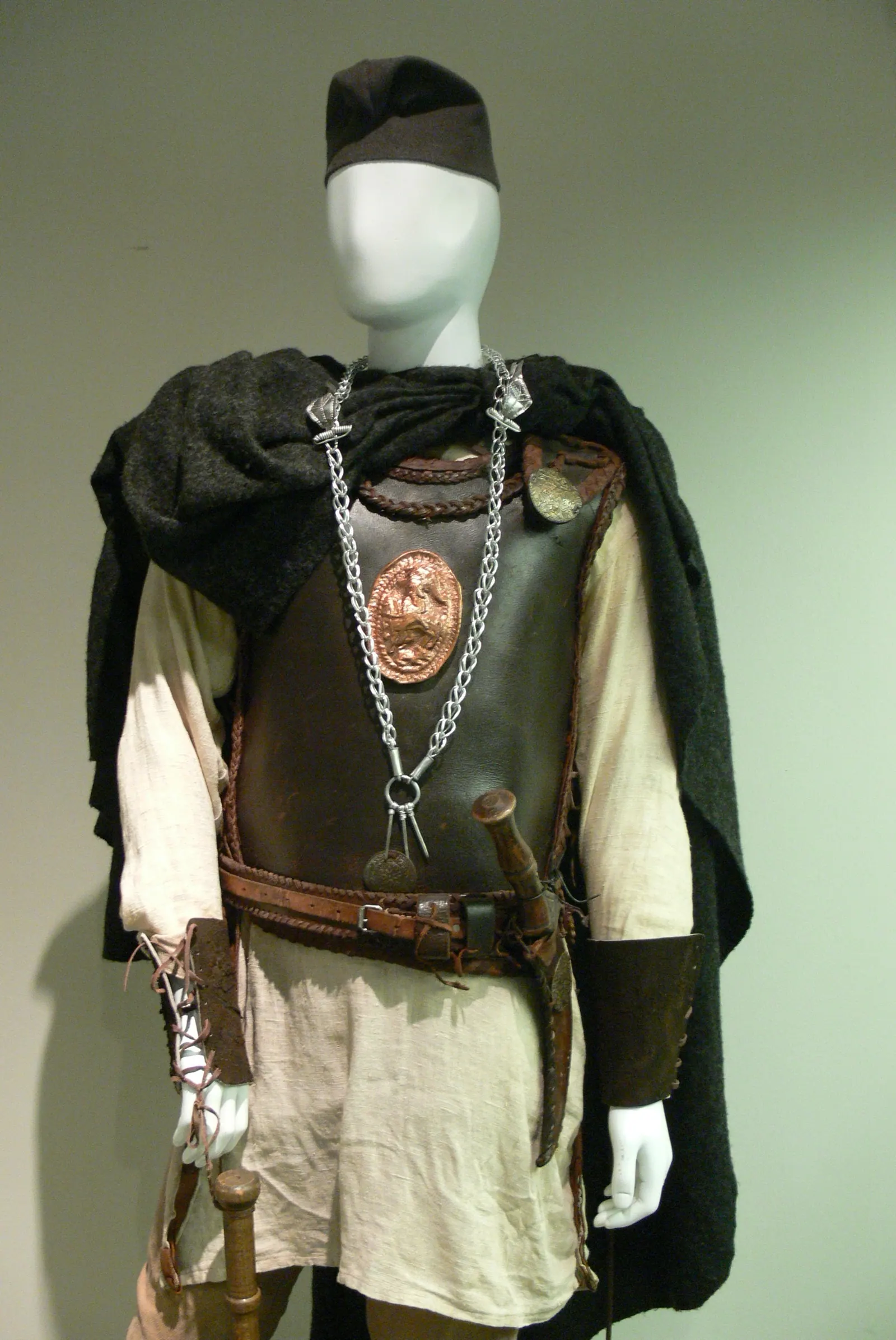 The dress of the Dacians
House and food
Dacian settlements were scattered farmsteads or groups on terraces, while the fortresses in the mountains housed the rulers. Archaeologists have found millet, barley and wheat, large storage vessels, hand mills and iron tools: the hoe, the sickle, the scythe. The Getae raised cattle, sheep and horses. Strabo says that king Burebista ordered the vines to be cut down, which shows that the Dacians knew the vine and wine, and that an order of this kind was considered worth remembering.
Beliefs and gestures
Herodotus describes the belief of the Dacians in immortality and the sending of the messenger to Zalmoxis, then the gesture of shooting arrows at the sky during a storm. These customs are the oldest we have in writing. The sanctuaries of Sarmizegetusa Regia, with rows of pillars and andesite discs, show that the rituals had a place of their own; what was done there exactly we do not know, and the explanations (calendar, astronomical observatory) are interpretations, debated among specialists.
What we know
- Herodotus describes the belief in immortality and the messenger sent to Zalmoxis.
- At Sarmizegetusa Regia there are sanctuaries with pillars and andesite discs.
What is debated
- The exact purpose of the sanctuaries: calendar, astronomical observatory, altar.
- What rituals were performed there.
Burial
In the Dacian cemeteries studied, cremation predominates: the ashes were placed in an urn or directly in the pit, together with vessels and, sometimes, weapons or ornaments. In the area of the Orăștie Mountains, burials under tumuli were also found. The custom fits with the idea, written by Herodotus, that death was not an end.
How those who met them saw them
Ovid, banished to Tomis, describes in Tristia the harsh winters and the frozen Danube, and the Getae appear in his verses with fur, bows and arrows. In Ex Ponto he says that he composed a poem in their language. The description is that of a sad man, hostile to the place, so it must be read with caution.
What remained in today’s culture
It is debated whether some elements of the folk costume, of carols or of the crafts of Romanian villages come from the time of the Dacians. Ethnologists can show similarities; direct continuity cannot be proved for every custom. That is why, on Explore Dacia, we keep the distinction between “attested among the Dacians” and “similar to what is preserved today”.
Direct continuity cannot be proved for every custom.
Sources
- Herodotus, Histories, IV, 93–96 (the belief in immortality, the messenger to Zalmoxis)
- Strabo, Geography, VII, 3 (the vines cut at the order of Burebista, Deceneus)
- Jordanes, Getica (“pileati” nobles and “hairy” common people)
- Ovid, Tristia, III, 10; Ex Ponto, IV, 13 (the winter and the dress of the Getae of Tomis)
- Trajan’s Column, Rome, 113 (the dress of the Dacians and of the nobles)
- National Museum of Romanian History, the permanent exhibition “Dacia” (pottery, tools and objects of dress)
Text written by Explore Dacia on the basis of the sources above; claims are attributed to their authors.