
Dacian legends and myths
Between source, legend and imagination
Almost all we have about the Dacians themselves are stories told by others: Greeks who knew them from trade and hearsay, Romans who fought them in war. These pages on legends keep the three layers apart, so that you always know what you are reading: what an ancient author says, what popular tradition added later, and what the modern age invented.
Zalmoxis: god, man or teacher?
The oldest text is by Herodotus (fifth century BC). He writes that the Getae “believe themselves immortal”: they do not die, but go to Zalmoxis, whom some call Gebeleizis. He also describes a custom: every five years the Getae chose a messenger and sent him to the god by throwing him onto spears held point upwards. If the messenger did not die, he was judged unworthy and they sent another. Herodotus also notes that in time of storm they shot arrows at the sky, threatening their god.
Herodotus adds what the Greeks of the Black Sea shore told: that Zalmoxis had been a man, a slave of Pythagoras, then free and rich, that he built a hall where he received his guests and spoke to them about the life after death, and that he then hid for three years in an underground dwelling, reappearing in the fourth. Herodotus says frankly that he does not quite believe the story and that he considers Zalmoxis much older than Pythagoras.
Plato (Charmides) mentions the physicians of Zalmoxis, who are said to have claimed that the body cannot be healed without the soul. Strabo (first century) repeats the link with Pythagoras and adds that Zalmoxis withdrew into a cave on a mountain considered holy. What remains certain: for the ancient authors, the Getae had a distinct belief in the survival of the soul. Who Zalmoxis really was remains an open debate among historians of religion.
They believe themselves immortal: they do not die, but go to Zalmoxis.
- Years between two sendings of the messenger to the god, according to Herodotus
- 5
- Years spent by Zalmoxis underground, according to the story of the Greeks
- 3
Kogaionon, the holy mountain
Strabo calls the sacred mountain Kogaionon and says that Zalmoxis had withdrawn there, and that later the king and the high priest stayed there. He does not say precisely where the mountain was. Many authors look for it in the area of the Orăștie Mountains, where the Dacian fortresses are found, but the location remains a hypothesis and not a proof.
What we know
- Herodotus, Plato and Strabo speak about Zalmoxis and about the belief of the Getae in the survival of the soul.
- Strabo names a holy mountain, Kogaionon.
What is debated
- Whether Zalmoxis was a god, a man or a teacher.
- The story with Pythagoras, which Herodotus himself doubts.
- Where exactly Kogaionon was.
Deceneus and Burebista
Strabo tells that king Burebista (first century BC) brought Dacia to power with the help of the priest Deceneus, a man who “knew the signs of the sky” and whom the people obeyed as a god. Strabo also writes that the king ordered the vines to be cut down and wine to be given up. Later, Jordanes (sixth century) makes Deceneus an adviser of some Gothic kings as well. The legend thus stretched over centuries, and part of it belongs to the Gothic tradition, not to the Dacians.
The draco, the standard of the Dacians
On Trajan’s Column, in the hands of the Dacian soldiers, there appears a standard with a wolf’s head and a serpent’s body, called in today’s language the draco. Arrian writes about such dragon banners, used by peoples of the steppe. The sources do not say that the draco was a sacred symbol of the Dacians; that meaning came later. What is certain is that the figure was used on the battlefield and that the Romans recognised it as Dacian in the sculpture of their victory.
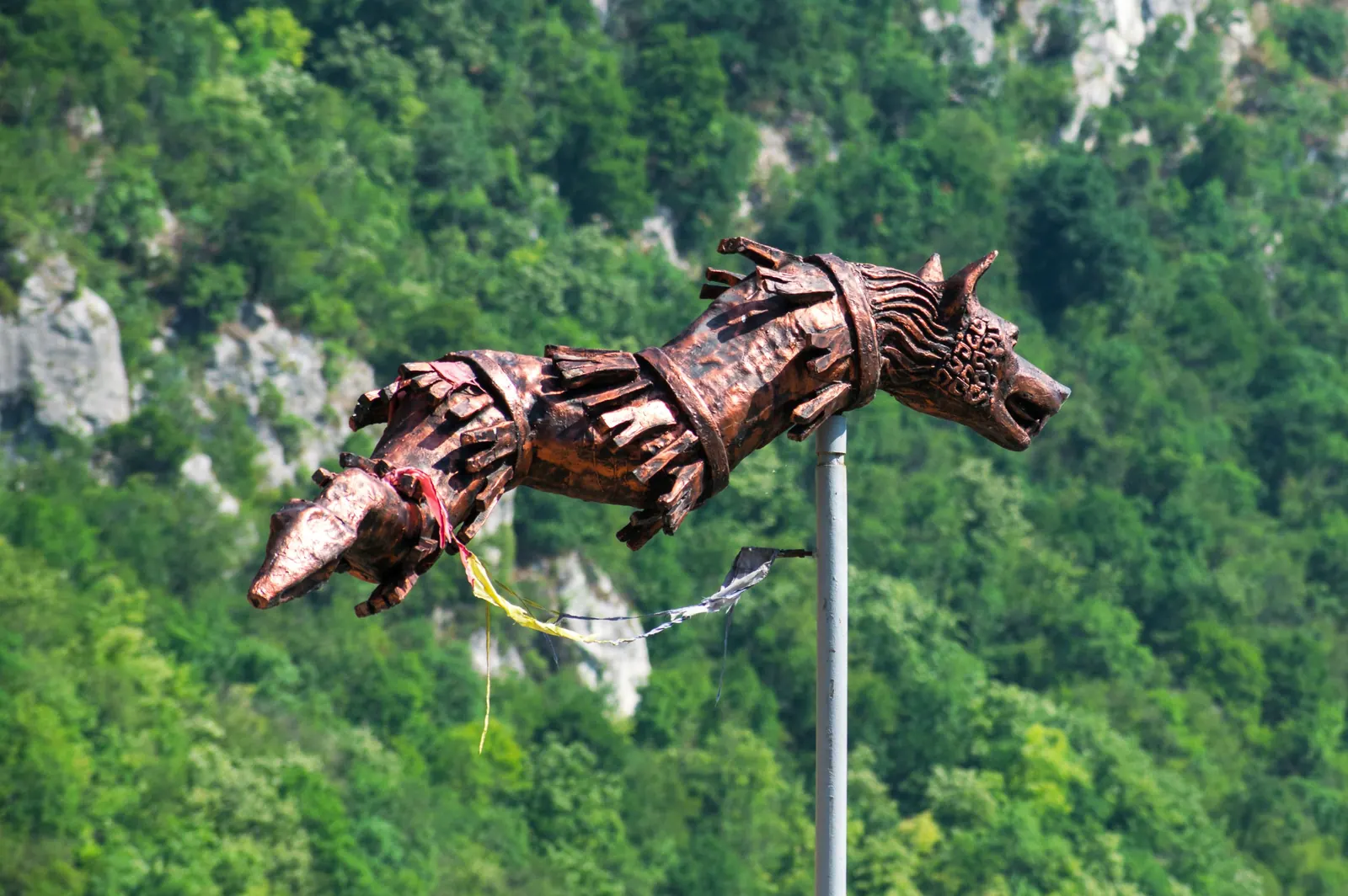 The Dacian draco (reconstruction)
The treasure of Decebalus
Cassius Dio relates that king Decebalus, before the defeat of 106, diverted the course of the river Sargetia, buried silver, gold and precious objects in its bed, then put the river back, and those who had done the work were killed. A prisoner, Bicilis, is said to have shown the place to the Romans. The same author says that Decebalus, pursued, took his own life. From here start old stories of hidden treasures. Archaeology, however, has not proved a treasure of Decebalus in particular; finds of gold jewellery exist, but they cannot be tied to this episode.
Decebalus diverted the river, buried the treasure in its bed and put the river back.
Arrows at the sky: the god of thunder
Herodotus (IV, 94) writes that when it thunders and lightens, the Getae shoot their arrows at the sky and threaten their god, because they do not think there is any god but their own. The source gives the god’s name in two ways, Zalmoxis and Gebeleizis, and historians of religion discuss whether it is one god or two. Herodotus does not say that he saw the custom; he reports it from others. It remains a very old picture of how outsiders saw the Getae’s faith: defiant, almost daring, before the powers of heaven.
The wolf and the name of the Dacians
Strabo (VII, 3, 12) says that the Dacians were first called daoi. The lexicon of Hesychius shows that a similar word, daos, meant “wolf” in the Phrygian language. From this came the hypothesis that the name of the Dacians means “those like wolves”. The hypothesis is very widespread, but it remains a hypothesis: the link between the two words cannot be proved. What is certain is that on Trajan’s Column the Dacians’ standard has a wolf’s head (see the dragon above). From these two threads our own time has woven the story of the “wolf Dacians”, a legend of the present, not of antiquity.
Dromichaites, Lysimachus and the plain table
Around 292 BC the Getic king Dromichaites took Lysimachus, one of the successors of Alexander the Great, prisoner in battle. Diodorus of Sicily (XXI, 11–12) and Pausanias (I, 9) tell what followed: the prisoner was invited to a feast with two tables, one laden, in the Macedonian manner, the other plain, in the Getic manner. The Getic king then asked him why he had brought war to a poor people and, once they had made peace, let him go. The capture of Lysimachus is mentioned by several authors, among them Strabo (VII, 3, 8). The scene of the feast belongs to the tale with a lesson that the Greeks kept, not to a document.
Later Romanian legends
The legend of Baba Dochia and the stories about Trajan and Dochia are kept in Romanian folklore and were collected by folklorists from the nineteenth century, among them Simion Florea Marian. They do not appear in any ancient source and, for historians, they say nothing certain about the Dacians. They are nevertheless a living part of how Romanians imagine their past, which is why we keep them here, with their label.
Baba Dochia and the nine sheepskin coats
The best-known legend of Romanian folklore about the beginning of spring was collected in the nineteenth century by Simion Florea Marian, in Sărbătorile la români (1898–1901). An old woman, Baba Dochia, climbs the mountain with her sheep in the first days of March, wearing nine sheepskin coats. When the sun warms, she takes them off one by one, but the cold returns, catches her without clothes and turns her to a rock, together with the sheep. The changeable days at the start of March are called “the old women’s days”. In some variants the legend is tied to Mount Ceahlău. A newer variant makes Dochia the daughter of Decebalus, who flees from Trajan and asks to be turned to stone: the story links folklore to the history of the Dacians, but it has no ancient source.
How we read a legend
- Ancient source: says what an author heard; we attribute it (“Herodotus writes that…”).
- Popular tradition: a legend collected later; beautiful, but with no value as historical proof.
- Modern invention: texts and “documents” presented as Dacian without a verifiable source; we treat them separately, with the position of Explore Dacia and the position of academic historiography (see the Sinaia Tablets).
Sources
- Herodotus, Histories, IV, 93–96 (the Getae, Zalmoxis and the messenger sent to the god)
- Plato, Charmides, 156d–157b (the physicians of Zalmoxis and the care for the soul)
- Strabo, Geography, VII, 3, 5 and 3, 11 (Zalmoxis, the mountain Kogaionon, Deceneus and Burebista)
- Jordanes, Getica (Deceneus, the adviser of Burebista, in the late Gothic tradition)
- Cassius Dio, Roman History, LXVIII, 14 (the hidden treasure of Decebalus and his end)
- Arrian, Ars Tactica, 35 (the dragon-shaped standards)
- Trajan’s Column, Rome, inaugurated in 113 (Dacian standards)
- Diodorus of Sicily, Historical Library, XXI, 11–12 (Dromichaites takes Lysimachus prisoner)
- Pausanias, Description of Greece, I, 9 (the capture of Lysimachus by the Getae)
- Hesychius, Lexicon, the word daos (“wolf” in the Phrygian language)
- Simion Florea Marian, Sărbătorile la români, 1898–1901 (the legend of Baba Dochia, collected from folklore)
Text written by Explore Dacia on the basis of the sources above; claims are attributed to their authors.